Friday, April 28, 2017

Mudlavia- The Chapel of the King's Daughters


Out of all of the fascinating stories about Mudlavia, the story behind the Mudlavia chapel is one of my favorites.
A man named Henry (who also went by Harry) Kramer opened Mudlavia in the spring of 1891. Henry Kramer was known as a brilliant entrepreneur, and gained great success from his pharmaceutical business and the Mudlavia Hotel.

In 1892, Henry Kramer married Miss Anna S. Moore, a local girl, whose family owned property around Mudlavia.

There is a ton of information on Henry Kramer, but there is very little information to be found on his wife, Anna. Most sources state the basics; she grew up in Warren County, she married Henry Kramer, and she had two sons.

Local newspapers wrote that when Mudlavia burned on February 29, 1920, Mrs. Kramer lost $25,000 worth of jewels in the fire.
If anyone had a fairy-tale story, it was Anna Moore Kramer. When she married Henry Kramer, she married into a life of success, wealth, and luxury. She raised her family on the fourth floor of the thriving hotel, surrounded by beautiful gardens, famous people, and extravagant parties. She had everything she could ever want.

Yet, there’s one more thing that she is known for, the building of the Mudlavia chapel.
One newspaper states that Mrs. H.L. Kramer had it in her heart to build a chapel near the hotel.

For Mrs. Kramer, Mudlavia was not complete without a place for the guests to worship and hear the word of the Lord, and she set forth to have a chapel built on the grounds. The rumor is that Mr. Kramer said she could build a chapel as long as she raised all the money herself.

An article from the Attica Ledger states, “Mrs. H.L. Kramer is interested in securing the funds for the erection of a chapel in which to hold religious services. She is an energetic worker and will no doubt succeed in the accomplishment of her purpose.”
And she did! Ground was broken for the chapel in August of 1897, six years after the hotel was built and five years after Anna married Henry Kramer.

She named the chapel, “The Chapel of the King’s Daughters”. The chapel could hold up to 250 people. One source describes it as a small Victorian style, wood-shingled church, while another source states that the chapel was of Gothic and Queen Anne architecture with stained-glass windows. At the front stood an organ and it had electric lighting (which was very modern for Warren County at the time)!

(Pictured above, one of the only pictures I have seen of the Mudlavia chapel from a postcard my sweet grandpa gave to me. This is a drawing done by an artist.)
The chapel was non-sectarian (nondenominational) and offered services on Wednesdays at half past seven, Sundays at two o’clock for Sunday school, and Sundays at three for the preaching service. They also used the chapel for recitals, lectures, and concerts on the other days of the week.

This link shows a rare picture of the Mudlavia Chapel from the collection of the Williamsport Washington Township Public Library.
http://www.wwtpl.lib.in.us/HistoryRecordView.aspx?historyRecordID=3157

Local preachers took turns preaching at Mudlavia. On one postcard, the letter writer wrote about a preacher that gave an excellent sermon on the 3rd commandment about not taking the Lord’s name in vain.

In the summer, it was common for the Mudlavia preachers to host baptisms at Pine Creek after church. Sometimes Mrs. Kramer hosted ice cream socials after the Sunday service and they often held church picnics after the service.
One secondary source stated that Mrs. Kramer decided to no longer open up church services to the locals due to their behavior, however, the next week they made amends and services were opened back up to the public (non-paying guests) again. So, not only was the chapel for the wealthy guests that stayed there, but she wanted everyone, even the locals, to have a place to worship.

Mudlavia was a place where people were healed through a special mud treatment. It was a place of breath-taking beauty. It was a place where people could come and find peace and relaxation from the rigors of life, and yet, Anna Kramer, who had all the worldly luxuries a girl could ever want, realized this wasn’t enough.

Mrs. Kramer knew there was more to life than riches, fame, success, and extravagance. She created a place where her guests could hear preaching twice a week and attend Sunday school, where they could get baptized, and where they could not just find healing for their bodily ailments, but healing for their souls through the chapel. She wanted this so badly, that she raised all the money to have it built herself.

I can picture her, standing in her lavish apartment on the fourth floor, reasoning with her husband as she stares out at the gorgeous grounds of Mudlavia and explaining why she wants a chapel so badly. “If we don’t have a chapel, we don’t have anything.”
An anonymous quote says, “I am a daughter of the King, who is not moved by the world. For my God is with me and goes before me. I do not fear because I am His.”

What an apt quote for Anna Kramer. She did not just settle into a life of luxury and was not moved by the wealth and success of the world around her, but worked hard to build a chapel to bring peace and healing to every guest who came to stay at Mudlavia.
While I have never known great wealth, her legacy speaks to me. Her legacy shows that wealth and fame aren’t everything. Her legacy shows that community is of great importance, that all people (whether wealthy guests or poor locals) should have the chance to worship in the church, and that while healing can come from various medicine and natural remedies, true healing comes from knowing the word of the Lord.

*Credit- The newspaper articles on the chapel came from the Warren County Historical Society. One article was partially ripped and the other very faded, so I am still trying to track down the newspapers and dates that the articles were written. Special thanks to Terri Wargo, who is in charge of the Warren County Historical Society. Special thanks to Chris Brown, the librarian of the Williamsport-Washington Public Library, who has given me permission to link the picture of the chapel to my blog.

Saturday, March 25, 2017

The Pieces of Mudlavia


I’ve had a lot of people ask me if I dropped off the face of the earth, and if I was still working on the Mudlavia book. The truth is, I’ve chased a rabbit down the rabbit hole. One trail leads to another, which leads to another, which leads to another. I am fine-tuning the details of my Mudlavia novel, and while writing the initial story was easy, researching it has been quite a challenging adventure.

If Mudlavia was a 10,000 piece jigsaw puzzle, it’s like someone stood in the middle of Indiana, and tossed the pieces into a windstorm, scattering them across the entire state. I’ve disappeared from social media to chase down all those pieces to hopefully put together a well-researched work of historical fiction.

Trying to track down the facts to get a picture of what Mudlavia was like in the 1900’s has been hard. One historian I worked with explained that there have been several people in the past who have talked about writing a book about Mudlavia, but no one has ever completed one. That’s because there are a lot of gaps in the research, there’s a lot of conflicting details from sources, and you really have to travel all over Indiana to find the information you are looking for. It seems like every person I talk to has a different piece of the puzzle. I always learn something new and I always walk away with more questions than what I started with.
The key to the missing answers?


I spent three hours reading the backs of old Mudlavia postcards to see if I could find any clues from the guests themselves.


The postcards, written so long ago, unveil a time when life was full of handsome fellows, picnicking, buggy rides, evening dances, and playing cards on the front porch.
Such beautiful handwriting on the postcards!
I read many accounts of guests who enjoyed the mud baths, two accounts of people who did not like being covered in mud at all, and one account of someone who was absolutely ecstatic because the dark mud made them look “just like real Africans”. The same words show up on many different postcards, describing Mudlavia as “a fine place”, “grand”, “beautiful”, and “especially delightful”, showcasing that this hotel was truly a place to behold.

I have not set out to write a nonfiction book about the Mudlavia Hotel, but a historical fiction. There’s a part of my brain that wants to find every little detail and fill in every little gap I’m missing. I still have a zillion questions about the hotel that can’t be answered unless I happen to fall into the right rabbit hole, but the other part of my brain is thankful for the missing pieces, because those are the parts I get to dream up and create to make the story come alive.

I am looking forward to sharing the information I’ve learned with you… missing pieces and all!

Sunday, August 21, 2016

Adventures At The Midwest Writers Workshop


“The world isn’t discovered in books and maps, it’s discovered out there,” Gandalf, The Lord of The Rings

I’ve never learned this lesson more than at the Midwest Writers Workshop. While it’s definitely a good thing to read writing books and blogs, nothing compares with sitting down with an agent or a best-selling author in a class or at lunch, and listening to them talk about their personal experience and share their best tips. It was mind blowing.


Day 1- getting ready to head "out there" to the Midwest Writers Workshop
I’ve always thought of writing as a solitary activity, and spend a lot of time writing by myself, but after a weekend at the Midwest Writers Workshop, I realized I’ve been missing out!

The conference made me see how important it is to connect with other writers. There is something to be said when you walk into a room and other people have pens tucked behind their ears, and way too many notebooks stuffed into their bags too!


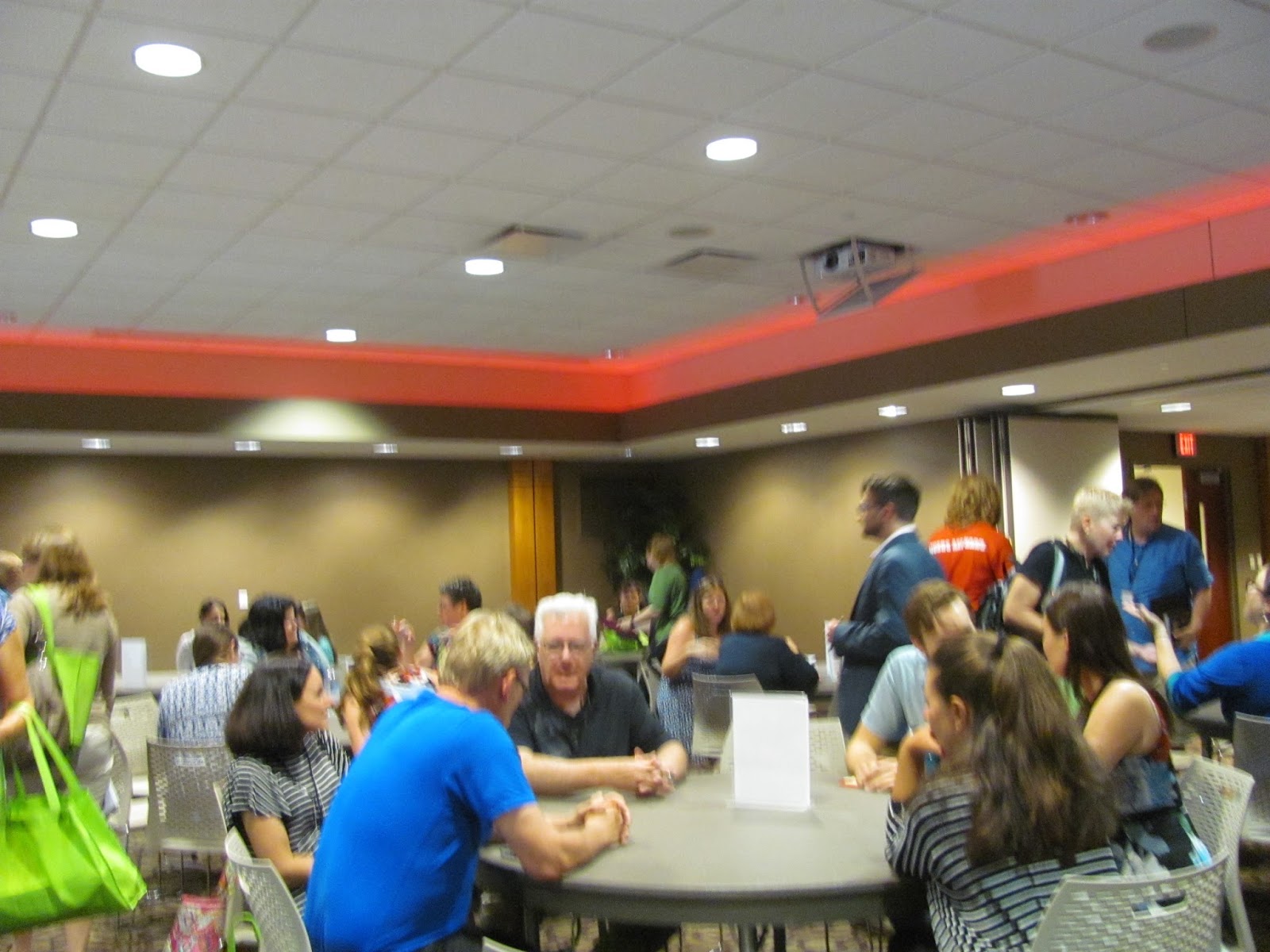
The picture above is from buttonhole the experts. They set up thirty different tables with experts who discuss all sorts topics applicable to writers . Some of these included; The Young Adult Market, Writing the Series, The Writer's Life, Ask An Agent Anything, and What's A Comp Title, just to name a few! They gave us two, one hour sessions with the experts, and after twenty minutes at the table, they rung a bell, and you had to run to another table. It was so hard to decide which tables to go to!The blurry picture above was fitting, because I was on the run!


These are some of the buttonhole topics. There was so much to learn from all of the experts, but my favorite was tips on self-promotion for the shy, introverted writer with expert author Lori Radar-Day. She was so fantastic that I  signed up to receive her e-mails and even bought her book.


Day 2- Taking a breath before I headed in to eat breakfast, listen to the "Ask an Agent" panel and do my first pitch session.
They had us running around from 8:00AM (if you wanted coffee and doughnuts) to 9:00PM (if you stayed for the activities after the dinner break) doing workshops, activities, and one-on-one sessions with the faculty. They offered classes about EVERYTHING! A few of the workshops I did were writing middle grade, editing, social media, and taxes for writers.


These are the schedules for the agents and authors. They kept us writers busy, but they kept the faculty even busier! I'm really thankful for how much time they put into the writers at the conference. What made this conference were the people. The staff was incredible. They were friendly and helpful, and more than willing to give me directions every time I got lost. I had imagined sitting in a huge lecture hall with one hundred other people and listening to an agent speak up front… not even close. There were only twenty or so in most of the workshops I took, and the agents, authors, and faculty were completely accessible. I had an agent sit next to me and ask me a question, and I was so star struck that I could barely get any words out of my mouth! They were all so down to earth and friendly, and genuinely wanted to help the writers there be successful.
I loved the workshops with the authors, because so many of them explained what it was really like once we signed a contract. It was so nice to have a heads up about what to look out for, tips on how to handle different situations, and what to expect once you sign with an agent and a publisher.


The picture above is from the social media workshop taught by agent, Lauren MacLeod. I needed this class in the worst way. She did a fantastic job explaining the ins and outs of social media. I tend to ignore social media, but she did an amazing job explaining why it’s such an important avenue for writers to use, and is the reason why you will see more blog posts coming from me in the future. I've always seen social media as daunting, but her tips were helpful, funny, and took the intimidation out of using it.

They offered one on one pitch sessions, query critiques, and manuscript critiques with the agents, editors, and authors!


I look all smiles, but I was SUPER nervous as I waited to do my query critique.


Day 3-This is me with Lisa Wheeler, who sponsors two scholarships for the Midwest Writers Workshop. What a privilege it was to meet her! Without her, I would have never had this opportunity and I am so grateful that she wanted to invest in the lives of writers. I love what she had to say about sponsoring the scholarships. She explained that she sponsors the scholarships to give someone else the opportunity to write and contribute to the good of writing in the world.

Tuesday, July 26, 2016

Mudlavia Pages Win Scholarship Contest!


In June, I was at McDonald's with my two girls. We’d spent twenty minutes scrounging up enough change to buy them each an ice cream cone, so I could use McDonald's free Wi-Fi without feeling guilty. At the end of a long day, the last thing I wanted to do was drive somewhere to use my email, and I was praying their internet would work well enough to send off my soccer documents and get on my way. I opened my e-mail and caught the subject line, “Congratulations Carrie” out of the corner of my eye. The sender… Midwest Writers. I couldn’t move. I couldn’t breathe. I couldn’t even click to open the e-mail.

I’d entered the scholarship contest back in May, submitting a letter and the first five pages of my Mudlavia novel. This wasn’t the usual friendly e-mail that said to try again next year, but to let me know they had chosen me as one of the scholarship recipients. In my day to day life, my car won’t always start, I don’t have internet access, I scrounge for nickels to buy my kids ice cream, and I surely can’t afford to attend a writing conference. Their e-mail changed my life, filling my summer with a little extra hope, excitement, and gratefulness.


It’s an honor to be chosen as a recipient, but an even bigger honor that it had to do with my Mudlavia novel. It’s a tribute to my grandparents, and it represents the people who have worked hard to preserve Mudlavia’s history. So many of them have welcomed me into their homes to share their knowledge and their Mudlavia collections with me. It represents a rich part of Indiana’s history that would be extinct without their stories, memories, and assortment of newspaper clippings, postcards, and artifacts. It represents the hard working and friendly people of Warren County, a place with Mayberry-like charm that’s never been lost over time. Some people have grossly misrepresented it on the internet, leaving people with a glum story about a crumbled building filled with ghosts. The Mudlavia Hotel deserves to be represented with its fascinating history, Titanic-like extravagance, and healing mud.


I was still in “pinch me” mode until I walked up to the registration table and they handed me my nametag. The nametag was my pass to the Midwest Writers Workshop in Muncie. Lots of writers blog about the importance of attending writing conferences, and they’re right. The conference was full of all kinds of writers with all kinds of stories, who were eager to share, learn, and network. Agents, editors, and best-selling authors attended the conference to teach us how to perfect our craft, market ourselves, and even handle taxes. If you have a chance to go to a conference, do it! There’s so much you can learn from talking to experts in person that you can’t learn from a book or a blog. If you can’t afford to go, see if they have some sort of scholarship contest and go for it… you might just get a surprising e-mail in your inbox!

Tuesday, June 21, 2016

The Mudlavia Project- Pine Village Football Team

If you’re driving through Pine Village, Indiana, don’t blink, or you might just miss it! Outsiders might think there’s not much to the town; a small post office, a little restaurant called The Windy Mill where the old farmers meet up to drink coffee, and a gas station where there’s no option to pay at the pump. It’s a charming place where the men wear overalls and everybody waves. And as you enter town, there’s a few curious signs claiming that Pine Village is where pro football got its start.

Side 1

If you were like me when I first moved to Pine Village six years ago, you might look at the surrounding corn fields and the county with no stoplights, and think, “Yeah right! This place couldn’t have any connection to the multibillion dollar football league we know today!”
Side 2
 I’m a pretty big football fan (although I don’t know if I’ll enjoy it as much this year now that Peyton Manning and Calvin Johnson are retired) and a history buff, so I became fascinated with these signs. Were they really true or were we just a small town trying to find our claim to fame?
I asked around and the common answer was, “Haven’t you read the signs?”

I was finally able to find good information on the Pine Village football team in a local publication called, The Good Ol’ Days, that was put together by Mary Ann Akers, and in the book, Pine Village Football The Inside “Dope” written by Doris Holtman Cottingham.

The first Pine Village team was founded by high school principal, Clint Beckett, in 1989. He was called the “father of Pine Village football” and it was his enthusiasm that turned the small town of Pine Village into football fanatics for over twenty years.

 The team played at the Pine Creek bottom on a cow pasture, where they hired young boys to pick up the cow pies before the games. From 1900 to 1914 the team was considered an amateur team, and the cost to get in was twenty-five cents. From 1915 to 1919, the team became pro and charged one dollar to get into games. Depending on the weather, they could expect anywhere from 300 to 4000 people pulled alongside the cow pasture in their buggies, and later on in their Oldsmobiles and Model T Fords.
The team was made up mostly of locals who worked on their farms during the week and then played in the games on Sunday afternoons. They were considered a “history-making bunch” because in twenty years, they only had six losses. They were not scored against during seven of those years, and went undefeated for eleven of those years!

The Pine Village team officially became a pro team when it was agreed upon that every player on the team would be paid $40 for each game they played in. Their first pro game was played on October 17, 1915, against the Marion Athletic Club. Pine Village was a town of 300 playing against Marion, a town of 10,000. Pine Village beat them 17-0.

In an interview written by Robert Carr, his uncle John Carr, who played on the Pine Village team, says , “That first game as professionals convinced us of one thing, we had to practice more and leave less to brute strength. What we did was start practicing three times a week in the main square at Pine Village. The area wasn’t actually large enough, but we had three 100-watt lightbulbs hanging from wires, so we really had it made.”

Sources say that famous athlete, Jim Thorpe, played at least one, but maybe even three games with the Pine Village team for a price of $250 per game. Newspapers record that Thorpe played in the Thanksgiving Day football game on November 25, 1915. Pine Village played the Wabash team made up of All-Americans from Notre Dame, University of Michigan, and Illinois. Pine Village beat them 29-0. In the article by Carr, he also interviewed Pine Village player, James Hooker, who said, “After that bruising game, Thorpe said he’d never seen anything like this in all his life. ‘Players from a tiny village playing like All-Americans against official All-Americans.’ ”

The Pine Village Football team is such an awesome part of Warren County’s history, and I’m really excited that they played games during the time that my Mudlavia novel is set. Although my focus is on Mudlavia, I love including other pieces of Warren County history into my novel, like my characters going to cheer on their Pine Village team!

Giving credit where credit is due:

Pine Village Football The Inside “Dope”, Doris Holtman Cottingham, Williamsport, IN 2001

Good Ol’ Days, “Game In Progress”, Mary Ann Akers, October 1988 (this contains the interview between Robert Carr and his uncle, John Carr)

Wednesday, May 25, 2016

The Mudlavia Project: Testing Recipes

Some of my favorite books are the ones that make you feel like you can almost taste and smell the food. I can't read anything by Beverly Lewis without feeling like I need a warm cup of coffee and a cinnamon roll. Harry Potter wouldn't be the same without its famous butterbeer, pumpkin pasties, and Bertie Botts Every Flavor Beans! And of course, we can't forget the hobbits who love all food and eat at least six meals a day; breakfast, second breakfast, elevensies, luncheon, and afternoon tea just to name a few!

When I write stories, it's really important to me to make the food come to life, and one of the best ways to do this is to test recipes. Not only is it a fun bonus to find a recipe from the story tucked in at the end of a book, but as an author is also helps me to make my story more real.

I have a special chef in my novel, who is based off a story told to me about a chef who used to work there. I have yet to find any information about this particular chef or any other chefs that were employed there, so its up to my imagination to determine what happens in the Mudlavia kitchen.

This is where testing recipes comes in. Not only can a I dream up some of the food they serve in my story, but by testing it, I get an idea of what problems they would have faced as they were trying to cook for so many guests! There were 250 guestrooms at Mudlavia, as well as day visitors, and the staff (in 1903, they had around 90 staff members working there), so there were a lot of mouths to feed!

I was testing a fancy apple recipe that is not pictured because it bombed. There was a very specific way to cut the apple and I cannot tell you how frustrated I was trying to get it just right. James even tried to help me and we had slippery apples flying all over our kitchen. As frustrated as I was with our apple fiasco, I realized later on how funny it would be to have the kitchen staff in my story going through bushels of apples and trying to get them just right for the evening dessert.

 I've come across a few different menus from Mudlavia that gave me a place to start, and I've been researching old-time recipes from the turn of the century. One recipe I found was a Lemon Pepper Cake recipe. Since lemons and pepper are cheap, it gave me a good place to start creating recipes!


Don't let those dark specks fool you! They look like flecks of vanilla bean, but they are actually specks of black pepper for an old fashioned style lemon pepper scone. I was wary of trying to put lemon and pepper in something sweet, but they turned out surprisingly good. The black pepper gives the sweet lemony scones a subtle note of heat.


While it was hard to wrap my mind around lemon pepper anything in something sweet, it was easier to pair the two in something more savory, like a biscuit. I found an old fashioned recipe for a cream biscuit, and since Mudlavia had their own creamery, it seemed very fitting to use a biscuit recipe with butter and cream! I then tinkered with it by adjusting the liquids and adding lemon and pepper to give it a distinct flavor.


This last recipe doesn't have anything to do with lemon or pepper (thank goodness- we were getting a little tired of that combination)! I came across an old cookie recipe that was similar to one my grandma and mom always made around Christmas time. Pictured above is the original recipe, but it has been the base for many other ideas, including the Old Fashioned Lemonade cookies I wrote about in my last post.

Thanks for reading and hope you enjoy!

Thursday, May 5, 2016

Mudlavia Project Update

I haven't posted any Mudlavia posts lately because I had deadlines for two contests this week. I started getting everything ready for them two weeks ago, and they took up a lot of my time.

The first one was to win a scholarship to attend a writing conference this summer. I had to submit the first five pages of my manuscript. I spent several hours editing those few pages, as well as double checking all my research to make sure it was right!

The second one was for a baking contest. You are probably wondering what this has to do with Mudlavia! For this book, I've had to research everything; clothes, trains, cars, medicine, and yes, food! I am fascinated by old Mudlavia menus, and anything I can learn about the kitchen and gardens there. The old menus have inspired me to recreate old recipes from the turn of the century.

Food Network had an ad for a baking contest, and I thought it would be fun to enter one of the recipes I made up. Pictured below are what I am calling Old Fashioned Lemonade Cookies. They were inspired by an old time recipe that was similar to a pecan cookie recipe my grandma and mom used to make at Christmas time. Once I had that recipe down, I turned it into a lemon cookie; partly because I've found several recipes from the turn of the century featuring lemon, and partly because of my dad, who adores anything with lemon in it.

You would never believe the complications with changing a few ingredients around in a recipe. People aren't joking when they say baking is a science- it took two to get the frosting right and five tries to get the dough right!

My book is coming along well. I have about 90,000 words written and I have started editing my first draft. My goal is to have it edited by the end of May before my girls are out of school. I still have a long way to go with the research to help fill in gaps in my story, but am really excited about how it is coming along. More posts to come soon! Thanks for reading!